The length of the pedal axle determines how far from the crank your feet stand. A standard axle is enough for most riders, but for some a longer axle prevents the heel from rubbing the crank and relieves the knee or hip. Research evidence is still scarce, so it relies mainly on fitters' experience.
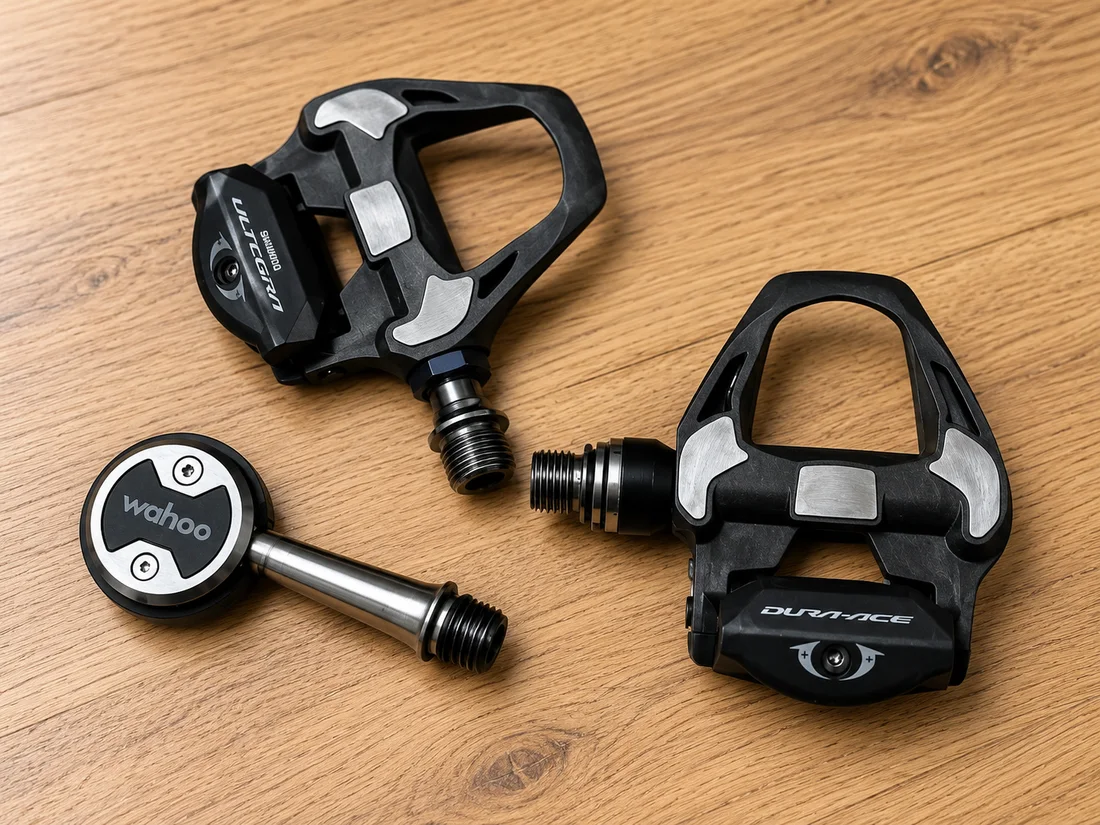
- The standard axle of road pedals is roughly 52–53 mm. Longer versions add 3 to 12 mm per side.
- A longer axle suits you when your heel rubs the crank (toes pointing out, “V feet”), when your knee drifts outward, or when the standard stance does not feel right.
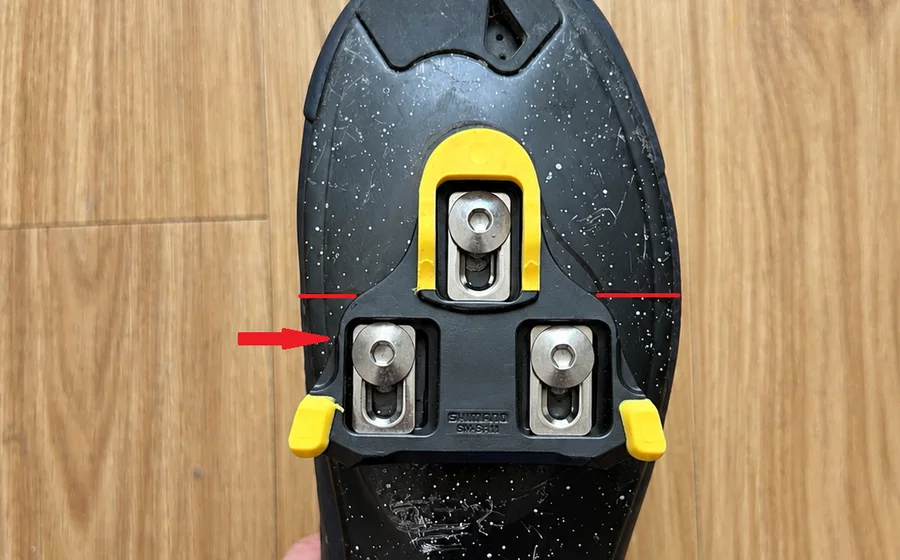
- First try moving the cleat and check the saddle height. Choose a longer axle only afterwards, and in small steps.
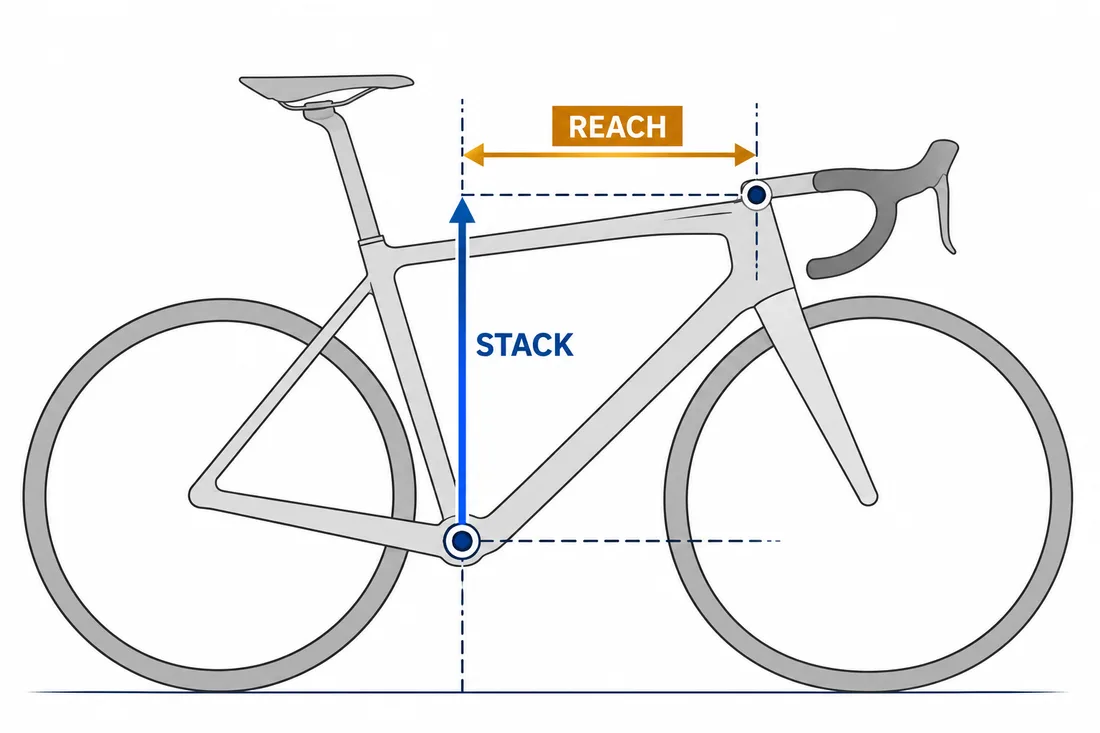
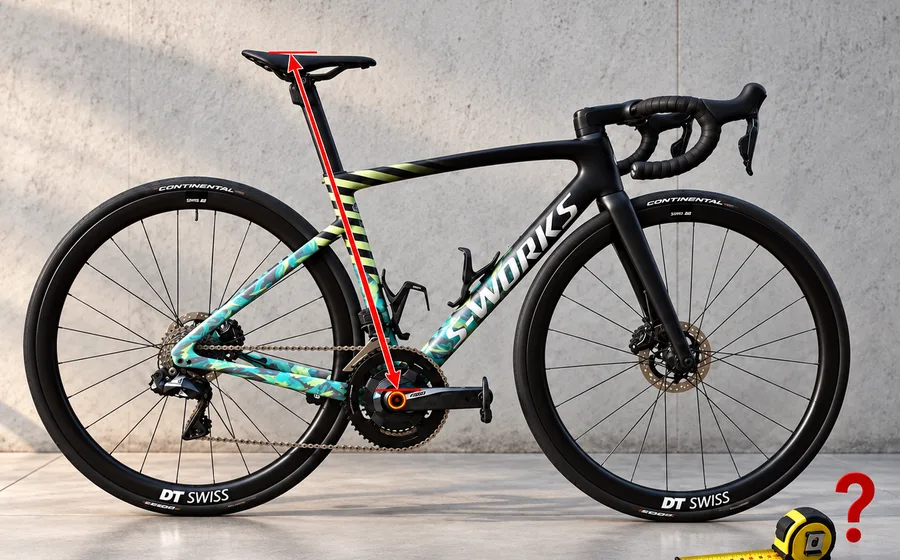
- You cannot judge stance width from a side photo. Judge it by feel, rubbing and a view from the front.
1. Three terms that often get mixed up
- Q-factor is the width of the cranks, that is the distance between the outer faces of the two cranks. Road cranks are about 145–150 mm (Shimano around 146 mm), mountain bike cranks about 168–170 mm.
- Axle length is the distance from the outer face of the crank to the centre of the pedal. Manufacturers sometimes wrongly call it the pedal Q-factor.
- Stance width is the distance between the centres of the two pedals. Example: 146 mm cranks and 53 mm axles give a 252 mm stance.
A longer axle therefore widens the stance, but the crank Q-factor does not change.
2. Who a longer axle suits
| What you notice | Why a longer axle may help |
|---|---|
| The heel rubs the crank while pedalling (typically when your toes point out, “V feet”) | the foot moves further from the crank and the heel has free space |
| Knees drift outward at the top and come back inward at the bottom | a wider stance can guide the knee more directly. But first check the saddle height; a saddle that is too low causes a similar movement |
| Wider hips or a different body build, pressure on the inside of the knee | the feet stand closer to the natural width of your legs |
| Modern cranks and a wide bottom bracket (BB) take away heel space | a longer axle gives back the lost clearance |
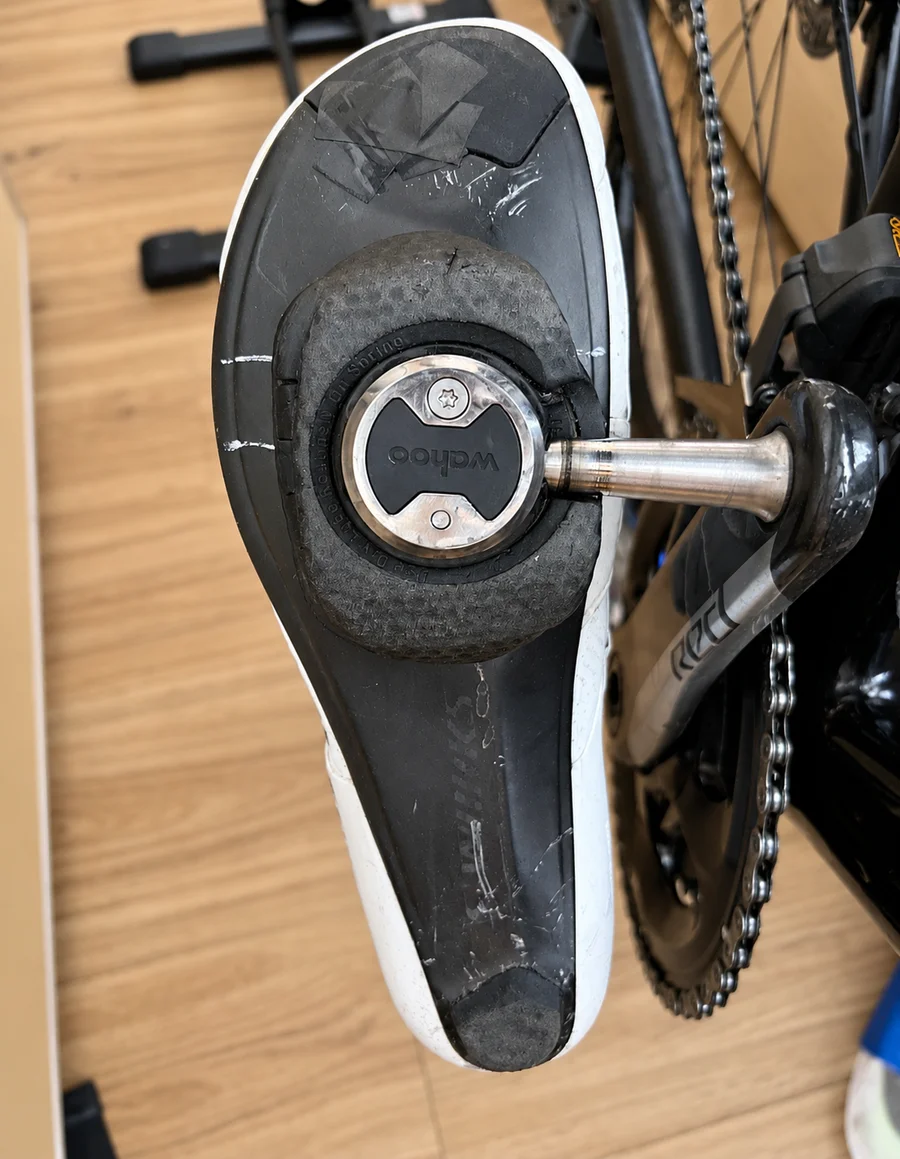
My feet are turned out more into a V and my heel used to rub the crank. Extended Wahoo Speedplay axles helped me and my hips felt more relaxed. Shimano cleats also did not allow the float I needed; Speedplay lets you set it (0° to 15° according to the manufacturer). This is a personal experience, not the result of a study.
Every leg is different. Fitters sometimes extend only one side.
3. What research says
There are few studies on stance width. One of the best known is the dissertation by B. Disley (University of Birmingham, 2014). It examined the effect of Q-factor on knee movement, efficiency and oxygen consumption in trained cyclists. According to the available abstract the effect of width was not clear-cut, and large differences between riders mean there is no single ideal width. It did not, however, test extended pedal axles or heel rubbing.
Fitting websites state that there are almost no articles on common stance-width formulas. The assumption that a small change of a few millimetres noticeably worsens aerodynamics or power is a guess. Comfort and clearance should therefore decide, not theory.
4. Available pedals and axle lengths
| Manufacturer, model | Standard axle | Longer (or shorter) variants | Note |
|---|---|---|---|
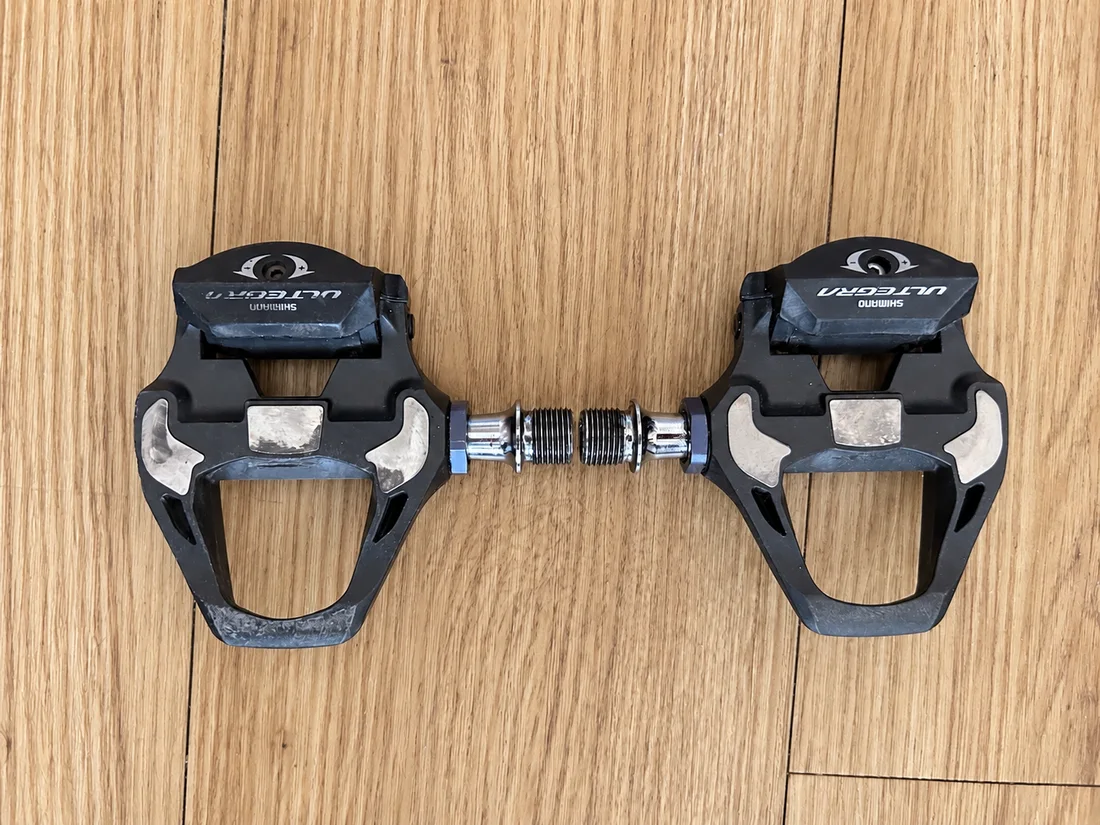
| Shimano Dura-Ace and Ultegra (SPD-SL) | about 52 mm | +4 mm (about 56 mm) | same platform, the difference is only in the axle |
| Wahoo Speedplay Zero | 53 mm | 56, 59 and 65 mm | longer axles are sold by Wahoo and fitters. Nano, Comp and Aero have 53 mm, Power 55 mm |
| Look Keo Blade | 53 mm | 56 mm | Keo Max and older Keo: 53 mm |
| Time Xpro (10, 12, 12 SL) | 53 mm | 51 mm (narrow), 57 mm (wide) | Xpresso has only one length |
| Garmin Rally (power meter) | 53 mm | 55 mm with the supplied 2 mm spacer | I did not find a longer axle |
Values are figures from manufacturers and retailers. The way of measuring differs; for Shimano sources give 52 to 54 mm, so rely on the +4 mm difference and confirm the exact length with the seller. For Wahoo Zero 55 mm is also quoted; catalogues differ.
5. What to try before buying longer pedals
| Solution | Note |
|---|---|
| Move the cleat towards the shoe, foot further out | the cheapest and you can try it right away, but the range is limited (with Look only about 5 mm sideways) |
| A spacer under the axle (about 1.5 mm) | only a small adjustment. Make sure enough thread remains in the pedal, at most one per pedal |
| Axle extender (e.g. 20 mm per side) | a big step and extra weight. Suitable more for marked deviations; discuss it with a fitter |
| A pedal with a longer axle | the clean solution: Speedplay 56–65 mm, Shimano +4 mm, Look Blade 56 mm, Time Xpro 57 mm |
6. How to proceed
- Check the saddle height and cleat position, because similar symptoms often have other causes.
- Try moving the cleat first, and only then change the axle.
- Start with the smallest step (Shimano +4 mm, Look 56 mm, Speedplay 56 mm) and ride at least several longer rides.
- Change only one thing at a time and judge each leg separately.
- Check the clearance: heel and crank, and with long threads also the chain or belt.
Changing the stance width changes the load on the knee and hip. If pain appears, go back to the original setting. With persistent pain or a big difference between the legs, see a bike fitter or physiotherapist.
Details and sources
Technical data come from manufacturers and retailers. There are few documented studies and most of the advice is based on fitters' practice.
- Wahoo, Speedplay axle lengths; Slowtwitch, new Speedplay lengths and why longer axles.
- Shimano, +4 mm axles for Dura-Ace and Ultegra (road.cc).
- Look, Keo Blade 56 mm (BikeRadar).
- Time, Xpro 51, 53 and 57 mm (road.cc). Garmin Rally: data from a retailer.
- BikeFit, stance width and Q-factor.
- B. Disley, Q Factor in cycling: kinematic and physiological effects (2014). Only the abstract was used, not the full text.
The advice is general, and the sources sometimes disagree in the numbers. When in doubt, have a fitter determine the axle.