Choosing the right bike size is one of the most important steps when buying a new road bike. It affects comfort, handling, pedalling efficiency and how long you can stay in the saddle without discomfort.
Many cyclists choose a frame mainly by their height or by the manufacturer's chart. That is a good start, but not always a reliable result. Two people of the same height can have different leg, torso and arm lengths, and so the same bike size may not suit them both.
So how do you choose the right size, which dimensions should you focus on and how do you tell that a frame really fits you?
Stack and reach appear in the geometry tables of gravel, mountain and trekking bikes too, so the basic principle applies to all bikes. The target position differs, though: gravel and MTB usually have a more upright and mobile position, often with a shorter reach and wider handlebars. This article is written for road bikes.
- Height and leg length are only the beginning; the number on the frame does not match between manufacturers.
- Compare stack and reach, not the label S, M or 54.
- On the border between two sizes, try the smaller frame first (my experience, not a study).
- Frame size and saddle height are two different things.
1. Start with your height and inseam length
The first step is to measure two basic values:
Height – measure barefoot, standing upright, ideally with your back to a wall.
Inseam length – measure the distance from the crotch to the floor.
You can measure the inseam roughly by standing with your back to a wall, feet about hip-width apart, and placing a book between your legs. Gently slide it upward, like a saddle when riding. Measure the distance from the top edge of the book to the floor.
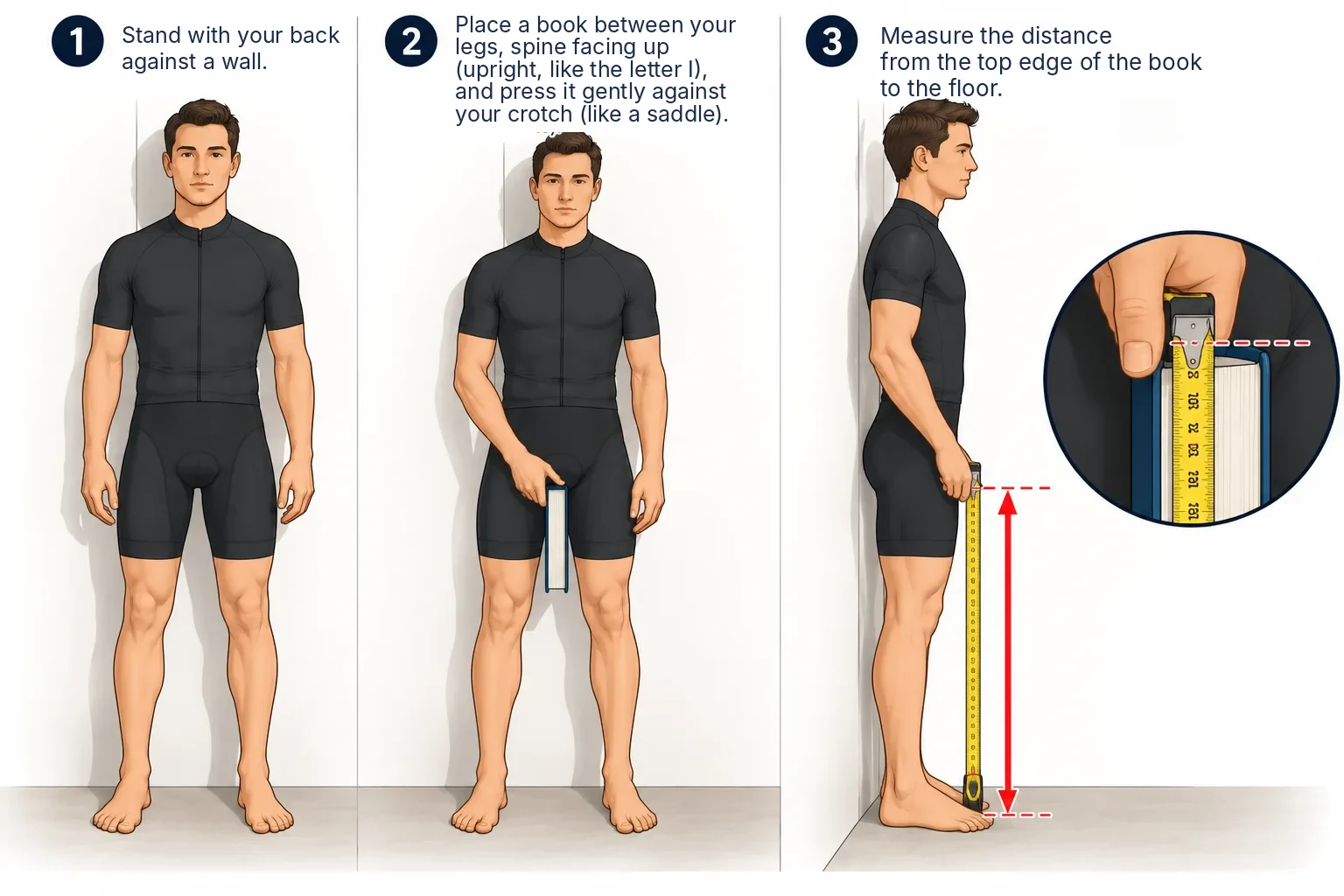
Repeat the measurement several times to minimise the error.
These values help determine a suitable range of sizes from the manufacturer's chart. On their own, however, they do not guarantee the right choice. Every manufacturer uses its own geometry and size labels.
From your leg length you can also quickly calculate an approximate saddle height. For the detailed procedure see the article How to set your saddle height.
A starting estimate from well-known formulas (LeMond, Hamley and Thomas), adjusted by my experience, deliberately leaning towards a lower saddle. The constants are my experience, not the result of a study. The final height is decided by the knee angle at the bottom of the stroke; pain or feel always win over the numbers.
2. Why are the labels S, M, L or size 54 not enough?
The size label is not consistent between manufacturers. A size 54 frame from one manufacturer may not have the same dimensions or ride characteristics as a size 54 from another.
For road bikes it therefore pays to watch two geometric parameters above all: stack and reach.
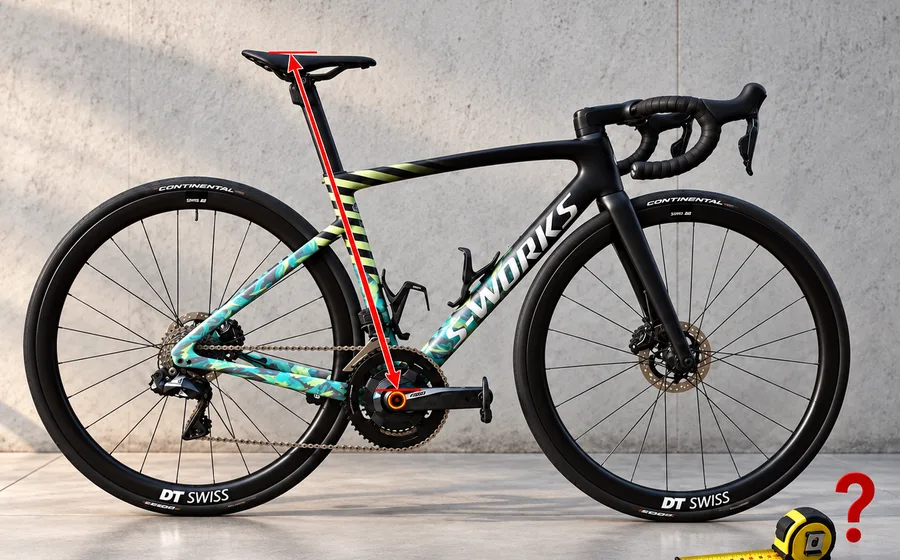
Stack – the height of the front of the frame
Stack is the vertical distance between the crank centre and the top of the head tube.
Put simply, it hints at how high the handlebars can be placed relative to the frame. A higher stack usually makes a more upright position easier to reach, while a lower stack offers more room for a low, sporty setup.
The resulting handlebar height is also affected by the headset, spacers, stem and the cockpit itself.
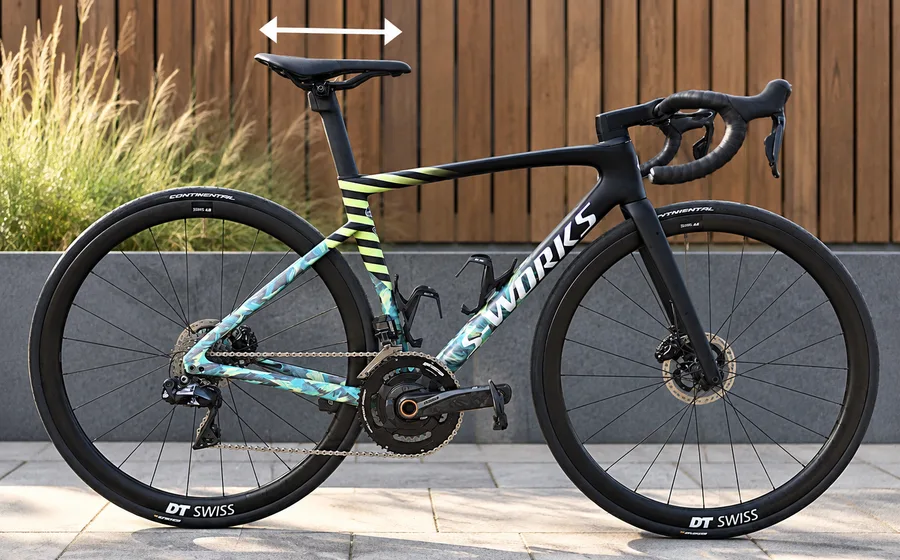
Reach – the length of the front of the frame
Reach is the horizontal distance between the crank centre and the top of the head tube.
It helps to compare how long a frame is in terms of its basic geometry. A longer reach generally means a longer frame base for setting up the position, but the resulting reach to the handlebars also depends on the stem length, the shape of the handlebars and the position of the levers.
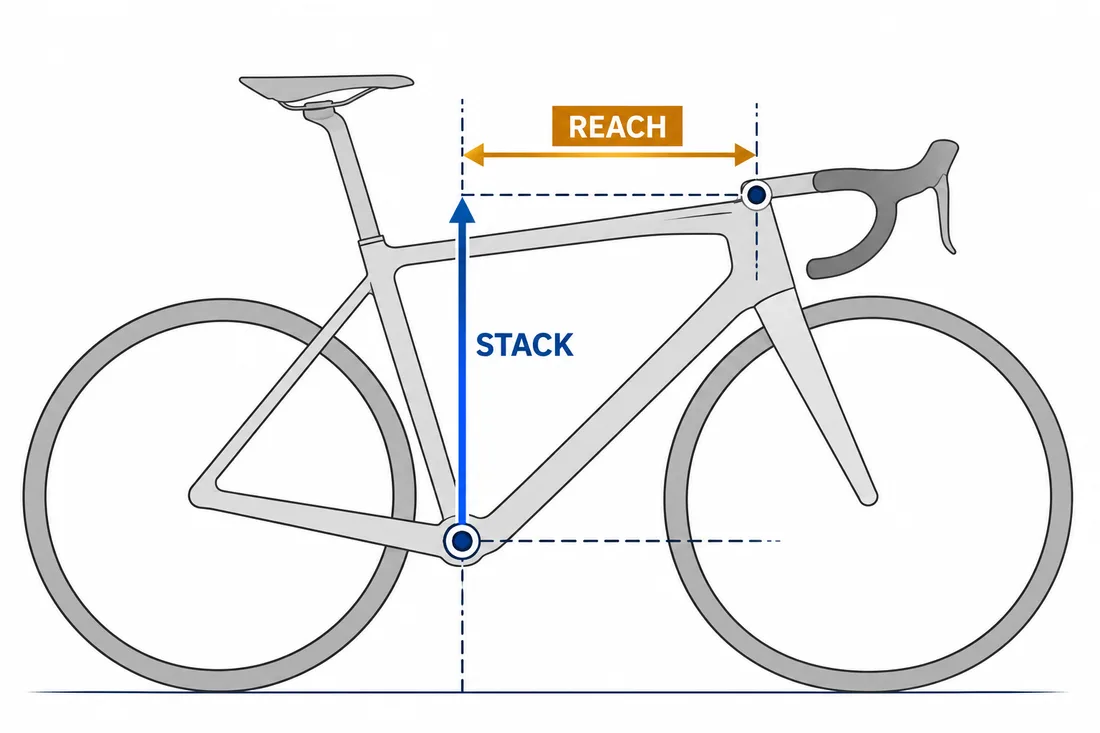
It is precisely the combination of stack and reach that is often more useful than the size number when comparing two frames.
Example (illustrative values): a size 54 frame from one manufacturer may have a stack of 540 mm and a reach of 380 mm, while a “fifty-four” from another has a stack of 560 mm and a reach of 392 mm. The number on the frame is the same, but the resulting handlebar position is not.
On road bikes the stand-over height is sometimes mentioned as well. For choosing a size it is not usually the main criterion; the geometry at the front of the frame and the ability to adjust both saddle and handlebars matter more.
3. How to tell that a frame is too big or too small?
A wrong frame size does not have to show up only as discomfort. It can also complicate the position setup and affect the handling of the bike.
A frame that is too big
It can show up, for example, like this:
You have to stretch excessively to the handlebars.
You feel pressure in your hands, shoulders or neck.
It is hard to reach a comfortable position on the hoods.
You need a very short stem or other major changes to reach a suitable position.
You feel the bike is too long or that you are too stretched out on it.
These symptoms do not automatically mean a frame that is too big, though. Similar problems can also be caused by an unsuitable position of the handlebars, saddle or levers.
A frame that is too small
It can show up, for example, like this:
You are too cramped on the bike.
The handlebars are too close to your body or it is hard to set a suitable reach.
The seatpost has to be extended much higher than usual.
You need a disproportionately long stem to reach the required position.
While riding you feel there is not enough room for a natural body position.
Here too these are not clear-cut diagnostic signs. What matters is the overall geometry, the range of adjustment and how the bike behaves when riding.
4. What if I am between two sizes?
Many people face this situation when choosing a road bike. According to the manufacturer's chart you may fall on the border between two sizes, and both options may make sense at first sight.
From my own experience I would rather recommend the smaller frame in such a case. This is a practical observation, not a rule backed by studies. A smaller size often leaves more room for fine-tuning the position with the seatpost, stem and other components. A larger frame, on the other hand, may be too long or may not offer such flexibility when looking for the ideal position.
That does not mean the smaller frame is always the right choice. It depends on the specific geometry, body proportions and the position you want. The smaller frame must still allow the correct saddle height, sufficient reach to the handlebars and stable handling of the bike.
When deciding, I therefore recommend comparing above all the stack and reach values of both sizes and checking whether the bike can be set up to your needs.
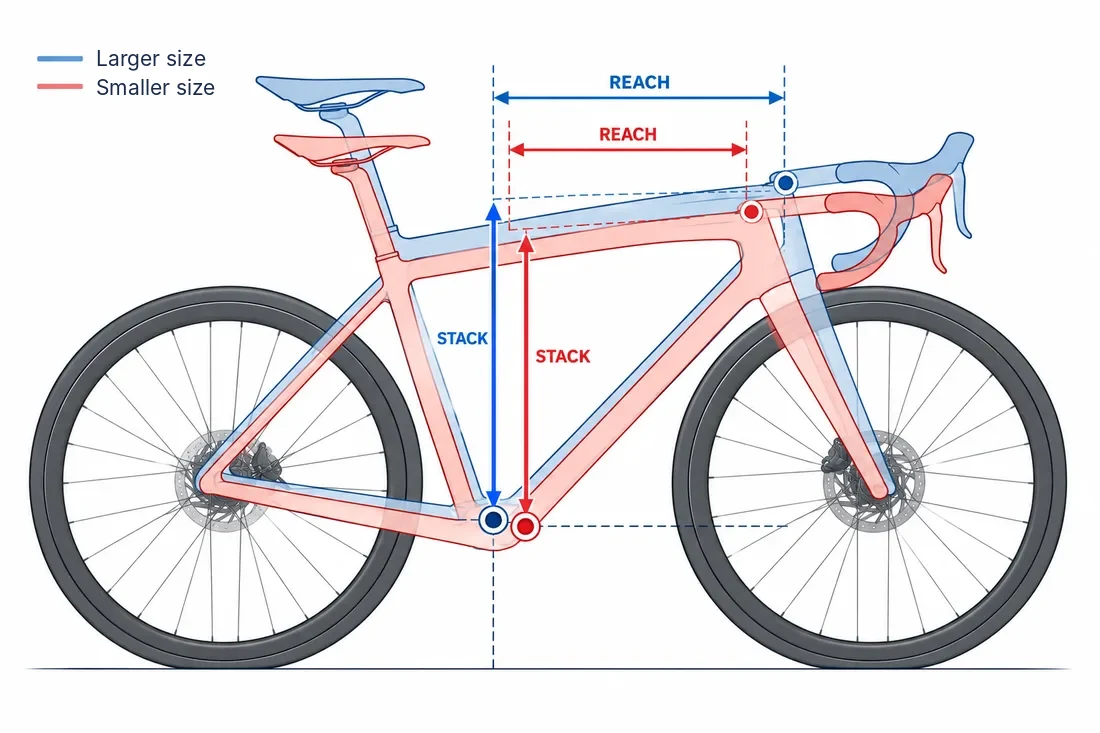
The practical recommendation is therefore: If you are on the border of two sizes, start by checking the smaller option. Only then compare whether the larger frame offers a real advantage in geometry and comfort.
5. Frame size and the right saddle height are two different things
A common mistake is the idea that if the saddle can be set to the right height, the frame size is automatically right.
Saddle height is only one part of the position. The right setup also depends on the fore-aft saddle position, the distance to the handlebars, the handlebar height and the position of the cleats.
A frame may allow the correct saddle height and still be too long, short, tall or low for the position you want.
When choosing, always judge the whole system, not just one dimension.
6. Why do torso length, arm length and body proportions matter too?
Imagine two cyclists who are both 175 cm tall. One has longer legs and a shorter torso, the other shorter legs and a longer torso.
Although they have the same height, their ideal bike setup can differ. The first may need a different saddle height and a shorter reach to the handlebars, while the second can make better use of a longer base geometry.
The result is also affected by the mobility of the hips, back and shoulders, the cyclist's experience and their goals. A racer looking for a low aerodynamic position may need a different setup than a cyclist who spends several hours in the saddle at a calmer pace.
There is therefore no single size that can be safely determined from height alone.
7. Can the right size be chosen from your current bike?
Yes, your current bike can be a very useful starting point, especially if its position suits you.
It is ideal to record:
the saddle height measured from the crank centre,
the fore-aft saddle position,
the handlebar height relative to the crank centre,
the horizontal distance from the saddle to the handlebars,
the stem length and handlebar dimensions,
the geometry of your current frame.
You can then compare these values with the geometry of the new bike and see whether a similar setup will be achievable.
Beware of simply comparing sizes, though. Two bikes of the same size can have a different stack, reach, head tube angle and other parameters. It is therefore better to compare specific dimensions and the resulting position of the contact points.
8. How can ComfiVelo help you choose a bike?
You do not have to deal with the right bike size and position setup only when discomfort appears while riding. It is ideal to check your position when choosing a new bike or soon after buying it.
ComfiVelo lets you quickly check your position by analysing a photo or video and get a better idea of whether your position on the bike matches the intended setup.
You can use the app especially in three situations:
When choosing a new bike: You try the bike in the shop and the analysis gives you more material to judge whether its size and basic geometry suit you.
When deciding between two sizes: You compare your position on both bikes and get a better idea of the differences.
After buying and when making adjustments: You check your position and verify changes after adjusting the saddle or handlebars. How to set the saddle height correctly is covered in a separate article.
ComfiVelo is designed so that a cyclist gets quick and clear feedback without having to evaluate every angle and dimension alone. The results can help with decisions, but they do not replace a professional bike fitting or an individual medical examination.
Choose a bike with more confidence. Check your position. And if something needs adjusting, find out where to start.
Conclusion: do not choose just the number on the frame
The right road bike size is not just a matter of height or the label S, M or 54. What matters is the frame geometry, especially stack and reach, body proportions, the position you want and the adjustment options of individual components.
With gravel and mountain bikes proceed the same way, that is compare stack and reach, but with regard to the terrain and the riding style you want. The saddle height found on a road bike can also be used on a gravel bike and MTB. In rougher terrain, according to fitters, set it a few millimetres lower to leave more room for body movement.
If you are choosing a new bike, start with your height and leg length, continue by comparing the geometry and finally check whether the bike can be set up in a comfortable and functional position.
The goal is not to choose the biggest or the smallest frame. The goal is to choose the frame that lets you reach the right position without needless compromises.
ComfiVelo helps cyclists better understand their position and how the bike setup translates into body position while riding.
The text is educational. Always verify the specific size choice against the geometry of the given model and the manufacturer's recommendations.