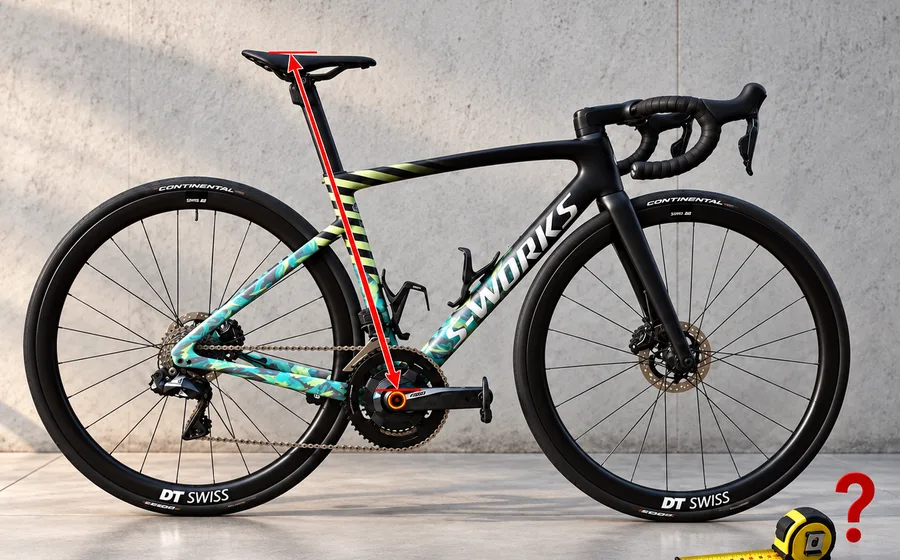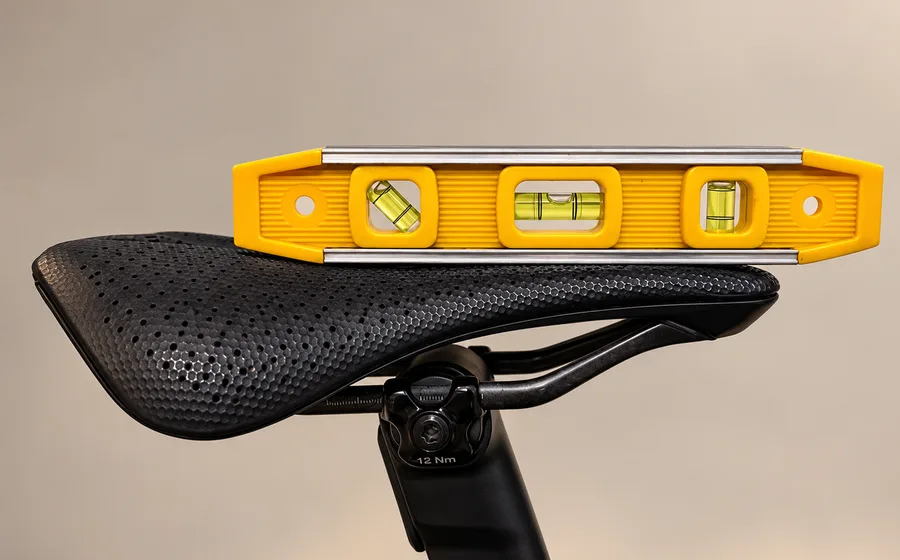
How far forward or back should the saddle be? For a long time the rule was that the kneecap should be exactly over the pedal axle. Today it is taken only as a guide, because we have no scientific basis for this rule. It helps you find a starting point; the final word belongs to comfort and hip angle.
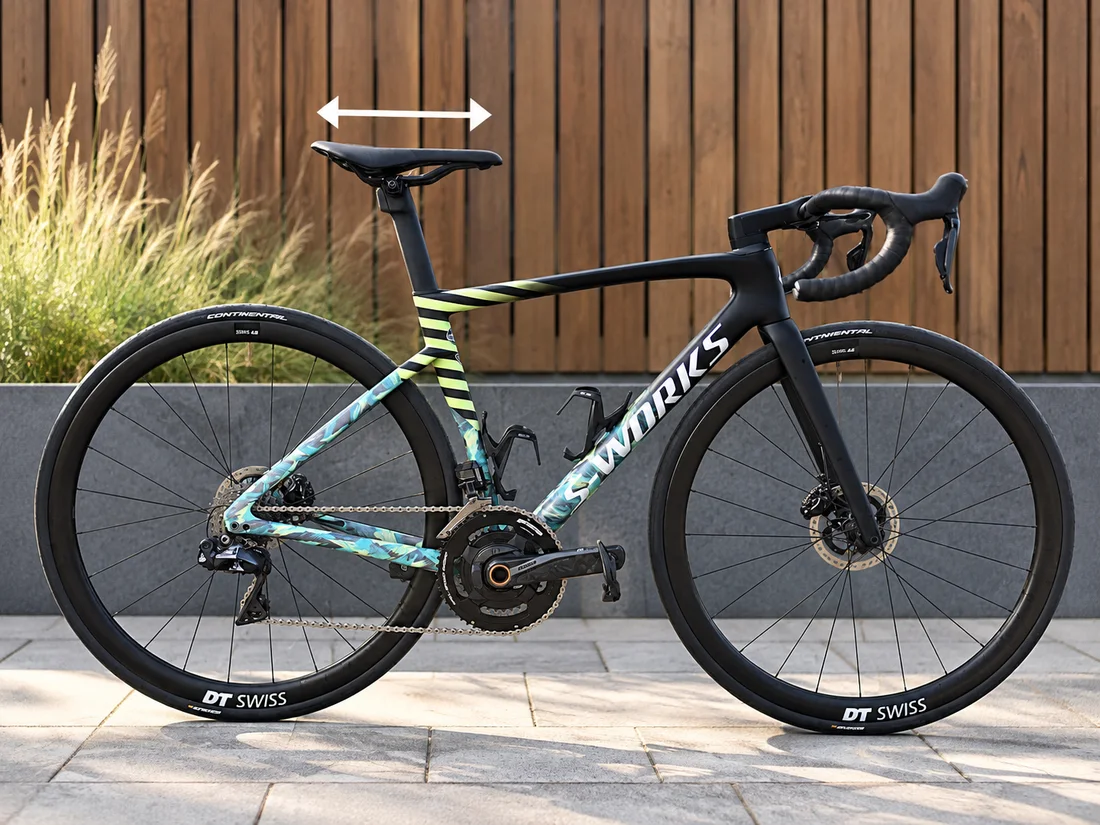
- Starting position: the middle of the saddle over the middle of the rails.
- The kneecap should be roughly above the pedal axle or slightly in front of it. It is a guide, not a rule.
- My experience: I recommend the kneecap more in front of the pedal axle. It is not the result of a study.
- Move in steps of 5 mm and after moving, lower the saddle slightly (when moving back) or raise it (when moving forward).
1. Where to start
Mount the saddle so that its middle is over the middle of the rails, that is in the middle of the range the seatpost allows. That gives you room to move in both directions.
The seatpost matters too. The position of the saddle relative to the bottom bracket depends not only on the rails but also on the seatpost offset (setback). Zero-offset seatposts are now widespread; they move the saddle, and with it the whole position on the bike, further forward than seatposts with setback. After changing the seatpost, therefore, check the kneecap position and the saddle height again.
2. The kneecap relative to the pedal axle
The kneecap position is measured when the crank is horizontal (the “3 o'clock” position). If you drop a plumb line from the kneecap, where does it land relative to the pedal axle? Plus means in front of the axle in the direction of travel.
The classic rule “kneecap exactly over the axle” (KOPS) has no scientific basis and fitters' recommendations differ widely. Modern practice moves the kneecap slightly forward. That is why ComfiVelo works with a wide range: for a Performance position from −5 to +25 mm, for a Comfort position from −5 to +15 mm. The values are indicative.
My experience: from tuning my own position on many bikes I recommend placing the kneecap more in front of the pedal axle rather than exactly above it. I feel more pressure on the pedal and a better transition over the top of the stroke (around 12 o'clock). These are my subjective feelings, not the result of a measurement or a study, so take it as a starting point and guide the tuning by feel and hip angle.
3. How to measure the kneecap position
- The crank is horizontal (3 o'clock), the pedal nearest the camera pointing forward. You can turn the crank by hand.
- The camera is exactly side-on to the bike at bottom bracket height and level, not tilted. A tilted phone distorts the vertical.
- The kneecap, the pedal axle and the crank centre (the bottom bracket axle) must be visible in the picture.
- Leave your foot on the pedal in its normal position; do not move your leg.
- Enter the correct crank length (it is usually printed on the crank); the scale is calculated from it.
Mark the pedal axle and crank centre by hand; that is the most accurate. The app can estimate the kneecap from the knee point, but it is only an estimate. That is why it suggests an adjustment only for a larger deviation.
4. How to move the saddle
- Make an adjustment only for a clear deviation from the range. With a small deviation, change nothing.
- Move in steps of 5 mm. For a larger deviation 10 mm. More at once is not recommended.
- Always change only one thing and take a ride after each adjustment.
5. Adjust the height after moving
After moving the saddle back, lower it slightly (by about a third of the shift); after moving it forward, raise it. The reason is the angle of the seat tube: the saddle moves along the rails, but that also changes its effective height above the pedals. Then check the knee again, see setting saddle height.
6. How you can tell the saddle is too far forward
Moving forward has its limits. According to a video by bike fitter Neill Stanbury (his experience as a fitter, not a study), a saddle that is too far forward shows itself like this:
- You “push” the pedal from the top down. A strong punch over the top of the stroke, but through the bottom of the revolution there is no control from the back of the thighs. The force arrives as a short peak and you stomp the pedal rather than spin it smoothly.
- More weight on the hands. Pressure on the palms, tingling or numbness in the hands, irritated trapezius muscles and tired triceps from leaning on the handlebars.
- The front of the thighs does the main work. During long hard efforts they burn faster than other muscles.
- Handling. The front wheel is heavily loaded, and the rear may lose traction when sprinting out of the saddle or in corners.
The same symptoms can also come from a saddle that is too high or, conversely, very low. That is why you change only one thing at a time. Stanbury also points out that the window in which the position is good is often narrow, only a few millimetres, and changes with fitness, mobility and strength. The position can therefore shift over time, and you should not be afraid to adjust it again.
A common mistake: do not shorten the reach to the handlebars by moving the saddle forward. That changes the relation of the pelvis to the pedals and spoils pedalling. Adjust the stem or handlebars instead.
7. Reach to the handlebars
Moving the saddle forward shortens the reach to the handlebars, moving it back lengthens it. In a Performance position the kneecap is usually slightly in front of the pedal axle, so moving forward also shortens the reach. With back or hand pain, first check handlebar height and reach before you touch the saddle.
The ComfiVelo app is being finished.Notify me