Crank length mainly changes how much the hip and knee bend while pedalling. Within the usual range it has a surprisingly small effect on power. That is why fitters and professionals are moving away from long cranks, and 165 to 170 mm is common.
- Power barely changes within the usual range of crank lengths, so you choose cranks mainly for comfort and hip mobility.
- A shorter crank opens the hip and knee angle at the top of the stroke. According to fitters, a crank 5 mm shorter opens the hip angle by roughly 2 to 3 %.
- Shorter cranks suit limited hip mobility, knee, hip or back pain, and a low position.
- After shortening, raise the saddle by the same amount. Adapting takes several weeks.
1. Who suits shorter and who longer
- Shorter (by 5 to 7.5 mm): limited hip mobility (desk job, older riders), pain at the front of the knee, hip or back pain, knee drifting outward at the top, a low aerodynamic position, triathlon and time trial.
- Rather longer: long thighs and good hip mobility, riders who need strength at low cadence (standing sprints, steep climbs).
2. What crank length you get
Enter your height and leg length (crotch to floor) and the app suggests a starting length. You then fine-tune it by feel.
| Height | Leg length | Traditional | Current standard |
|---|
The table is a summary of fitting practice, not the result of a single study. Traditional values are based on frame size and leg length; today's standard is roughly one step shorter. Between two sizes, take the shorter one.
3. How to tell your cranks are long
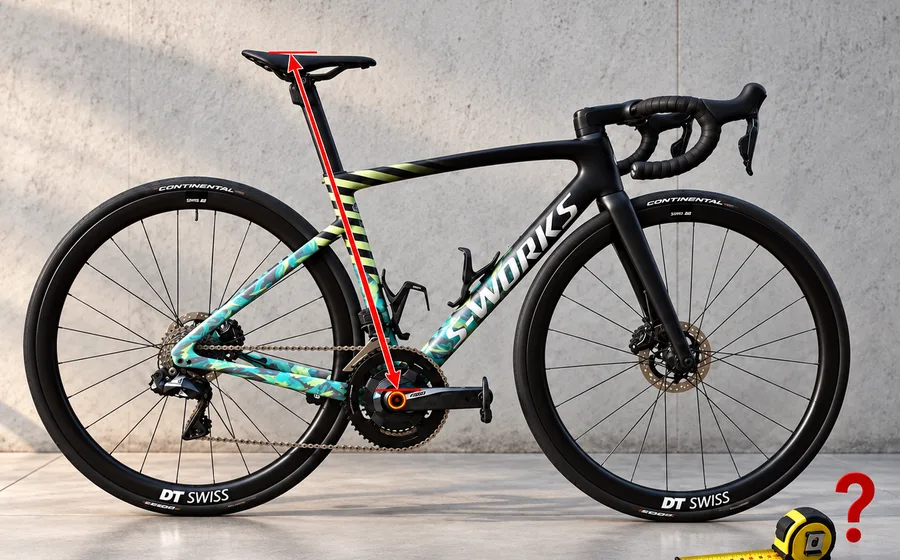
- You cannot raise the saddle to the ideal height, because your hip closes at the top or you overextend your ankle at the bottom.
- The knee drifts outward at the top.
- The thigh hits your ribs or belly when you ride in the drops.
- Try pedalling backwards at 60 rpm. If the movement catches at the top, the hip may be restricted.
- In the app: if the knee is too bent at the top, the app suggests shorter cranks and raising the saddle by the same amount.
4. After the change
- Raise the saddle by the difference in lengths. Someone who buys shorter cranks and leaves the saddle makes the position worse.
- Change in steps of 2.5 to 5 mm. According to fitters, going from 170 to 165 mm is quick, from 175 to 165 mm takes longer. Expect weeks, and do not change just before an important event.
- Availability: Shimano and SRAM road cranks start at 160 mm, Campagnolo at 165 mm. Smaller manufacturers also offer 150 to 155 mm.
5. Cadence and pedalling style
Power is torque times rotational speed. You can ride with force (a heavier gear, lower cadence) or with frequency (a lighter gear, higher cadence). Low cadence loads the muscles more, high cadence the heart and breathing. With a shorter crank you usually spin a little faster, but there is no need to force the cadence.
| Style | Cadence | What it loads more | Caution |
|---|---|---|---|
| Strength, heavier gear | 60–80 rpm | leg muscles | too low a cadence loads the knees |
| All-round | 80–90 rpm | balance of muscles and heart | a fit amateur usually rides 80–90 |
| High cadence, lighter gear | 90–100 rpm and more | heart and breathing | too high a cadence: rocking pelvis, back |
- Strength training: 50 to 55 rpm seated, 76 to 94 % of threshold power, intervals of 5 to 10 minutes, 20 to 40 minutes in total, in blocks of 2 to 3 weeks.
- Cadence training: 4 × (4 minutes at 120 rpm + 1 minute easy) with a calm upper body.
Too low a cadence with a heavy gear loads the knees, while too high a cadence rocks the pelvis and hurts the back. With pain, first check the saddle height, cleats and cadence.
The ComfiVelo app is being finished.Notify me
Details and sources
What research says
- Power: Martin and Spirduso (2001, 16 trained riders, cranks 120 to 220 mm) measured the highest maximal power at 145 and 170 mm and the lowest at 220 mm (1194 and 1149 W, a difference of about 4 %). In the 145 to 170 mm range the difference was around 1.6 %.
- Joints: Barratt et al. (2016, 15 riders, 150 to 190 mm, 240 W at 90 rpm): the range of motion at the hip and knee grows with crank length, but the distribution of work between the joints was preserved.
- Efficiency: a small 2017 study (12 amateurs, preferred length ±5 mm): efficiency did not change (about 20 %), a longer crank increased hip and knee flexion. The authors advise choosing the shorter one when in doubt.
- Elite riders: Cal Poly (2018, 18 riders, 150 to 180 mm): higher efficiency at 150 mm (22.1 % vs 21.6 %), a smaller range of motion at the hip (45° vs 51°) and knee (67° vs 75°), a higher optimal cadence (130 vs 120 rpm). Preliminary results from a university report.
- 2025: a British study (14 amateurs, five lengths around the preferred one): power was the same, shorter cranks reduced hip and knee flexion. Another (28 trained men, 165, 170 and 175 mm): perceived exertion was lower at 165 mm than at 175 mm.
- Cadence: a laboratory study on 8 men (190 minutes of riding): efficiency at 80 rpm about 22.8 %, at 100 rpm 21.3 %; after riding at 80 rpm the power in the final test was about 9.7 % higher. The sample is small and sprints and time trials were not tested.
- Aerodynamics: fitter Phil Burt describes the case of Bradley Wiggins (from 177.5 to 165 mm, the front end 30 mm lower, drag about 3.5 % smaller). That is a story, not a controlled study.
What studies cannot settle: most are short-term, with few people and mostly men. Long-term adaptation and the effect on injuries are not well measured. Shorter cranks may take away leverage at very low cadence (down to roughly 30 rpm), for example when starting from a standstill.
Sources
Martin and Spirduso 2001, summary of Martin's study, Barratt et al. 2016, J Sports Sci 2017, Cal Poly 2018, Sports Biomechanics 2025, J Exerc Sci Fit 2025, JSSM 2014, cadence, road.cc, Cycling Weekly, Steve Hogg, Brújula Bike, Thick Bits, BikeRadar, TrainRight.
The content is informative. Sources are given for verification; the numbers come from abstracts and summaries, and advice in the literature differs. Treat it as indicative.