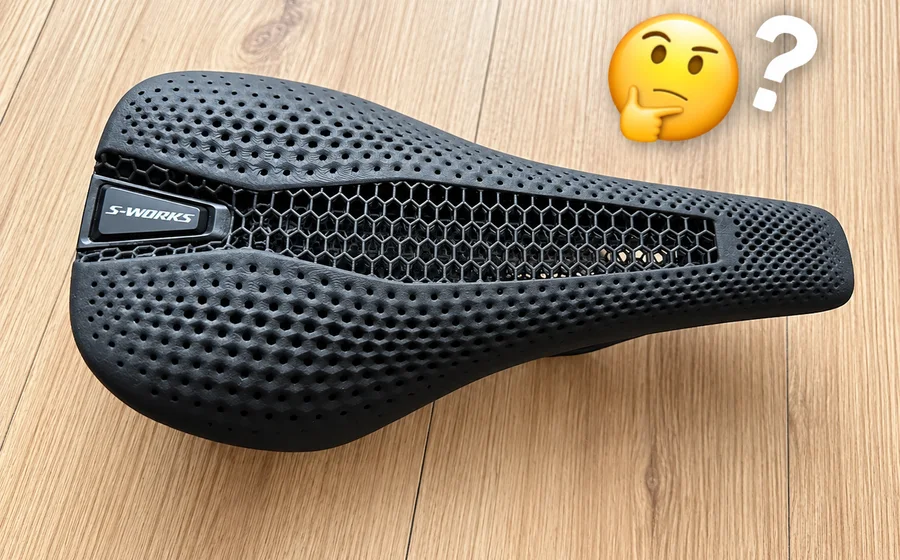
Saddle tilt is a small adjustment, but it decides how you feel on the saddle. Usually it is enough to start level and change in small steps.
- The starting tilt is level; you measure it with a spirit level on the saddle.
- For a saddle curved along its length, measure on the front, flatter part.
- My experience: a tilt of about 1° nose down. It is not the result of a study.
- Change in steps of 1 to 2°.
1. Start level
The starting position is a level saddle. Place a spirit level on it and set it flat. The bike must stand on a perfectly level surface; ideally check with the spirit level between the wheel axles. If the surface is a degree off, the saddle tilt will be a degree off too.
2. Where exactly to measure
If the saddle is curved along its length, that is, the rear part is raised, measure the tilt on the front, flatter part of the saddle, not along its whole length. Otherwise you would set the saddle by the raised rear part and the nose would point somewhere other than you expect. In the photo the spirit level rests on the saddle with the bubble in the middle, so it is level.
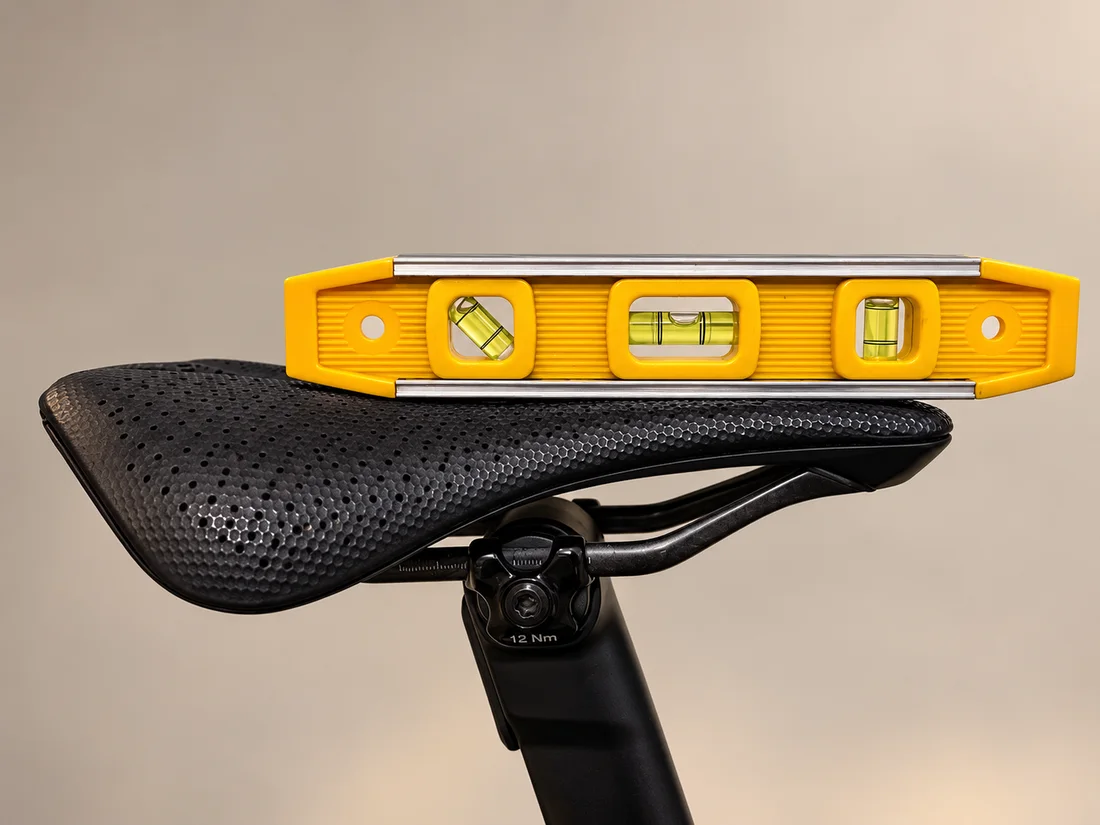
Saddles with a more pronounced curve, on the other hand, are usually set slightly nose down, so the front part should not be exactly level, but a small gap remains between it and the spirit level. How big depends on the shape of the saddle, which is why you tune the tilt in small steps.
3. The author's recommendation
I use a tilt of about 1° nose down. It is based on experience, not on a study. Take it as a starting point from which you can fine-tune by feel.
4. How to change the tilt
- Change in steps of 1 to 2° and take a ride after each adjustment.
- Always change only one thing, so that you know what helped.
- Go more nose down only for pressure on soft tissue, not because of saddle height or reach to the handlebars. Other adjustments are for those.
5. How you can tell the tilt is wrong
From my experience (not from a study), a wrong tilt shows in what the saddle does to the rider:
- Too far nose down: the pelvis tips forward, you start sliding forward on the saddle and shift weight onto your hands. Numb hands and more tired thighs follow.
- Too far nose up: the front of the saddle presses into soft tissue, in men and women alike. The pelvis tries to get away from the pressure toward the back.
- Test in the drops: you ride evenly on the hoods and the saddle is fine, but in the drops it starts to press after half a minute or a minute. The saddle is probably nose up, or its shape does not suit you because it does not let you tip far enough forward.
The angle at which the problem appears is very individual. It depends on the shape of the pelvis, on mobility and strength, and on the saddle itself. With tilt I would not chase aerodynamics or power, but look for comfort and stability. Some saddles are very sensitive to a change of angle and even half a degree can make riding better or worse, so do not be afraid to play with it.
The ComfiVelo app is being finished.Notify me