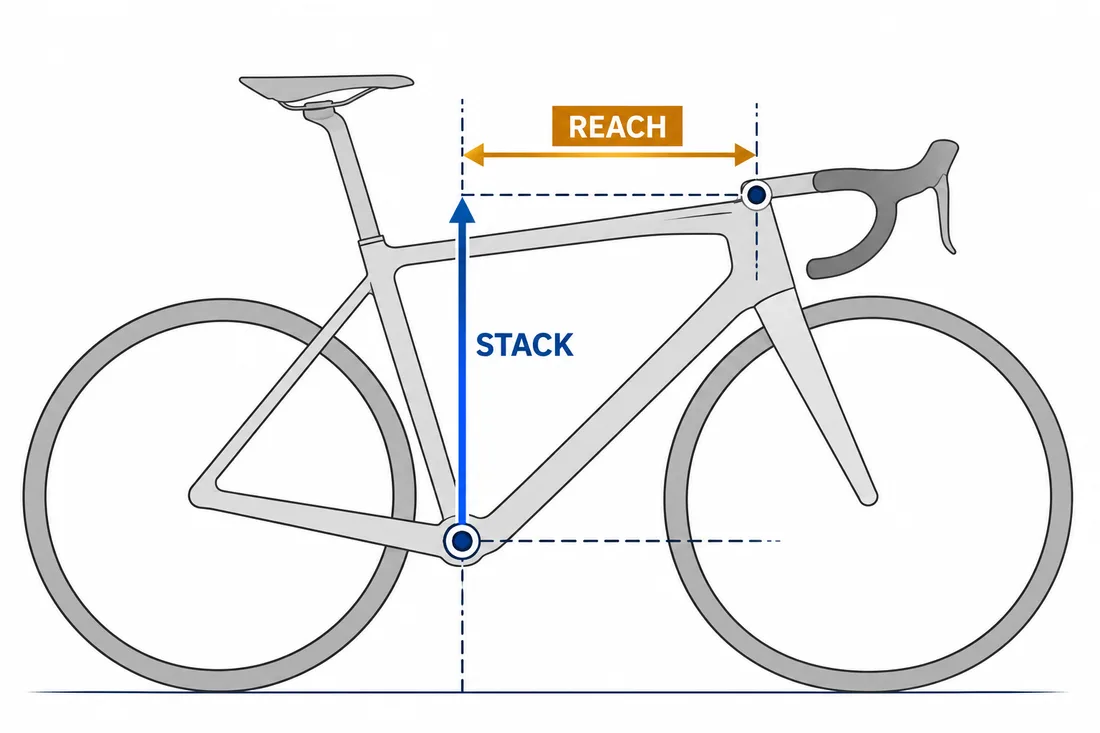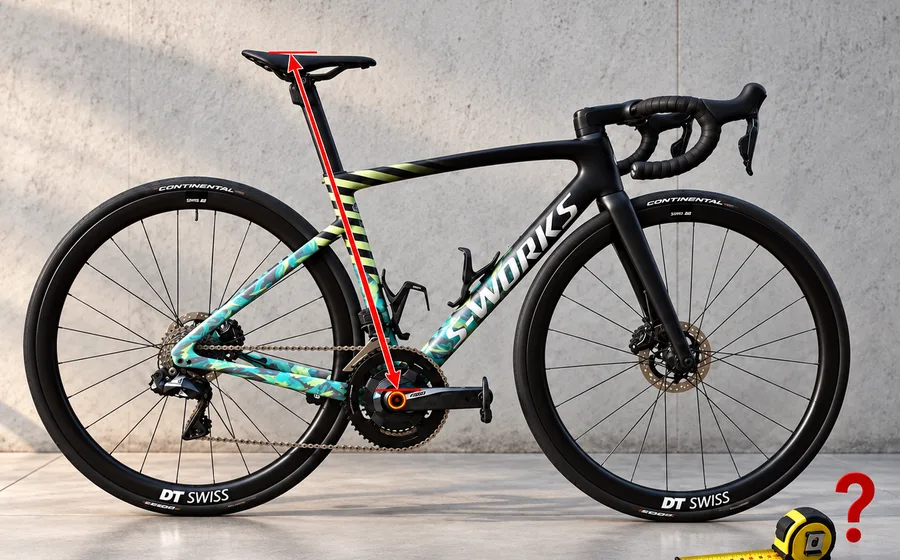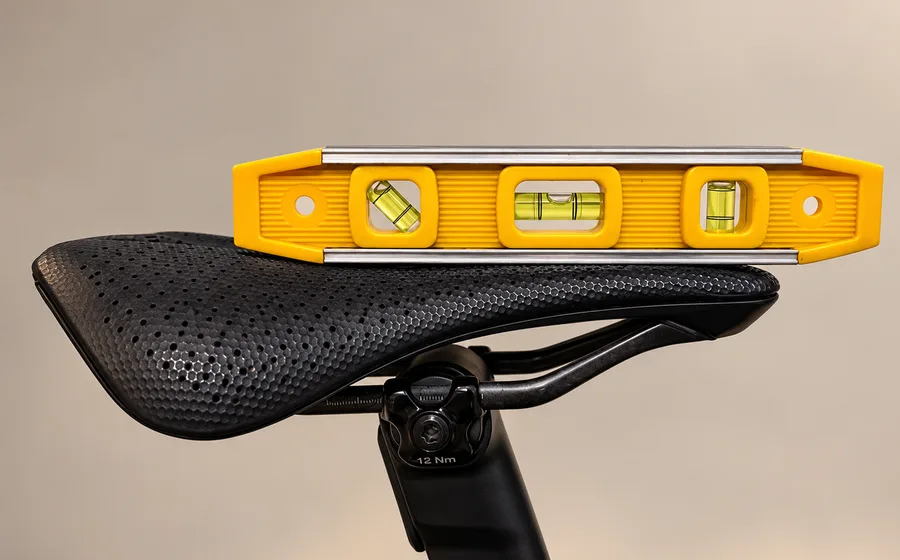
A well-set-up bike is the foundation, but your body has to be able to stay in that position. Your hips, lower back and neck do the same job for hours while riding, and that is exactly where limited mobility shows up first.
- Position and mobility complement each other. A bike will not help if your body cannot handle the position, and exercises will not fix a badly set-up bike.
- The most common weak spots are the front of the hips, the back of the thighs, the lower back and the neck.
- About 10 minutes, several times a week, is enough. Regularity matters more than length.
- Movement before a ride, slow stretching after a ride or in the evening.
- Never push through sharp pain, tingling or a pinching feeling in a joint.
1. What the riding position does to your body
- Hips are constantly flexed while riding and open and close with every pedal stroke. If you also sit at work, you spend most of the day flexed. The front of the hip shortens and limits how freely the hip opens during the stroke.
- Back of the thighs and pelvis. When the hamstrings are short, they pull the pelvis backward and the lower back rounds. The forward lean then comes from the lower back instead of the hips.
- Lower back and chest. Several hours in a forward lean loads the lower back. A stiff chest can make it worse, because it takes a smaller share of the lean than it could.
- Neck. In a forward lean you have to lift your head to see ahead. The neck muscles then hold its weight for hours in a row.
Studies show associations between mobility, position on the bike and pain. They are not proof that a particular exercise will cure pain. Regular movement is, however, cheap and generally safe, and physiotherapists commonly recommend it to cyclists.
2. How to exercise so that it makes sense
| When | What | How long |
|---|---|---|
| Before a ride | dynamic: cat-cow, leg circles and swings, lunges without holding | 3–5 min |
| After a ride | slow stretching of the hips and the back of the thighs | 30–60 s per side |
| Evening or on a rest day | the whole routine from this article | 10–15 min, 3–5× a week |
| During a sedentary day | stand up, walk around, a few steps in a lunge | a short break after each hour of sitting |
- Do not hold long stretches before a ride. A short stretch is fine; a long one right before an effort can take away strength for a while.
- To improve mobility, roughly 10 minutes a week per muscle group is enough. More does not help on its own.
- It should feel like a mild pull, not pain. Breathe calmly and do not bounce.
- The immediate effect fades quickly. A lasting change comes after weeks of regular exercise.
3. Eight exercises
The figures are schematic. The working zone is marked in yellow.
Hips and back of the thighs
1. Kneeling lunge
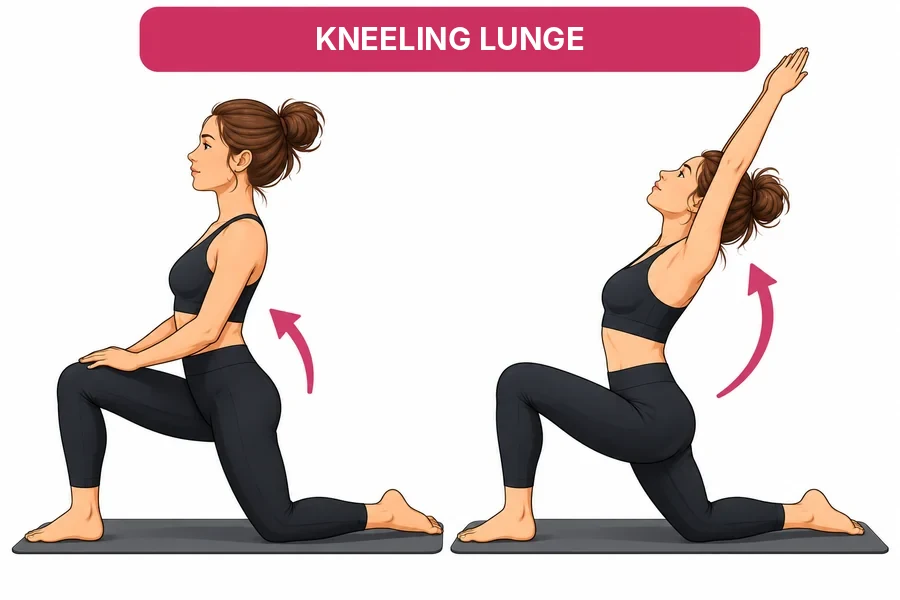
- Target: the front of the hip (mainly of the back leg).
- How: Kneel on one knee (pad it), put the other foot in front of you with the foot flat on the floor. Tuck the pelvis under, as if you were tightening the glute on the side of the kneeling leg, and slowly shift it forward until you feel a pull at the front of the hip. The torso stays upright.
- Dose: 2× 30–45 s per side.
- Watch out: the pull belongs in the hip, not in the knee and not in the lower back. If the lower back arches, reduce the range.
2. 90/90 knee switch
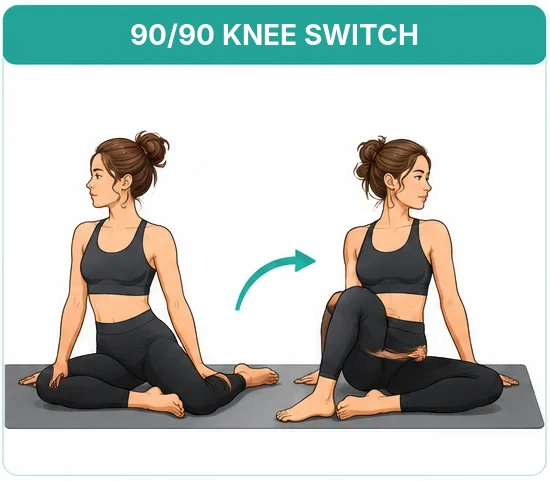
- Target: hip rotation, both internal and external.
- How: Sit on the floor, one leg bent in front of you and the other out to the side, both knees at about 90°. Sitting tall, slowly switch the knees to the other side, without help from your hands if you can.
- Dose: 8–10 switches, slowly.
- Watch out: the movement comes from the hips, not the back. If it is hard, sit on a cushion or support yourself with your hands. Pain in the knees means a smaller range.
3. Figure-four stretch (lying)
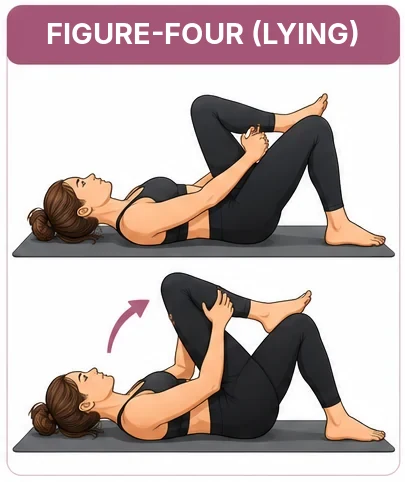
- Target: the glutes and the muscles around the hip.
- How: Lie on your back with both knees bent. Place the ankle of one leg on the knee of the other and use your hands to draw the lower thigh toward your chest until you feel a pull in the glute. Head and shoulders stay on the floor.
- Dose: 45–60 s per side.
- Watch out: the pull belongs in the glute. Pain inside the knee or in the groin is a sign to reduce the range.
4. Hamstring stretch with strap
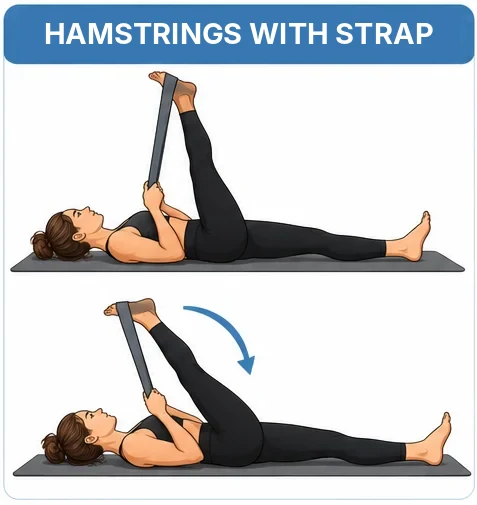
- Target: the hamstrings, which influence pelvic tilt.
- How: Lie on your back. Put a strap or towel around the foot of the raised leg, the other leg lies flat. Straighten the knee only until you first feel a pull and keep the lower back on the floor.
- Dose: 2× 30–45 s per side.
- Watch out: the knee may stay slightly bent. A pull behind the knee is fine, tingling in the leg is not.
Lower back and chest
5. Cat-cow
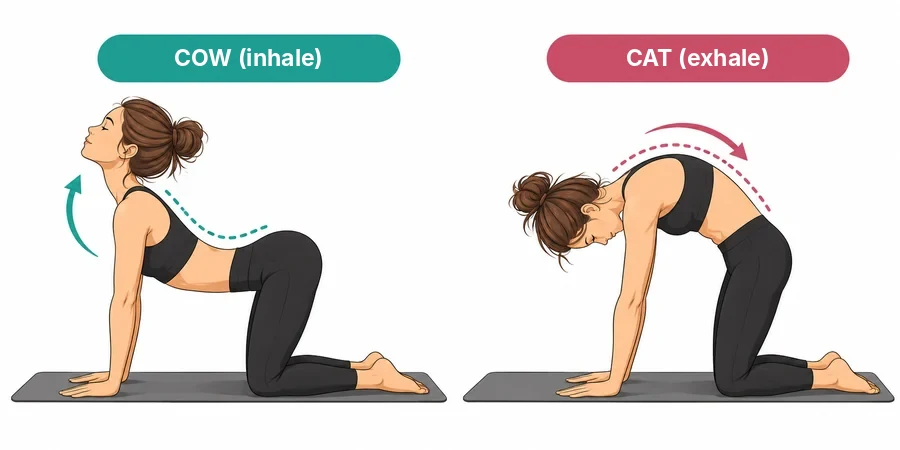
- Target: gentle mobility of the whole spine.
- How: On all fours, hands under shoulders and knees under hips. As you exhale, round your back and draw your chin toward your chest; as you inhale, gently arch your back and look ahead.
- Dose: 8–10 slow repetitions.
- Watch out: a controlled movement, not forcing into the end position. If your wrists hurt, lean on your fists or forearms.
6. Open book
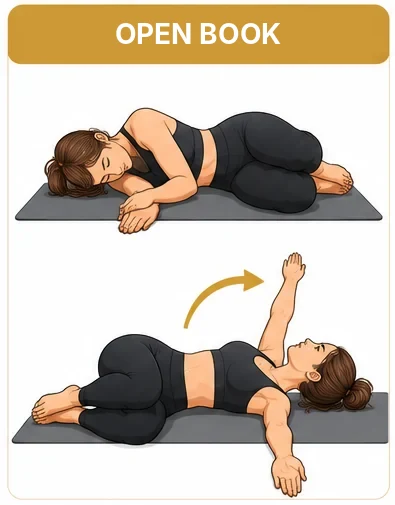
- Target: rotation of the thoracic spine, which also helps the neck.
- How: Lie on your side with the knees bent and stacked, arms stretched out in front of you. Open the top arm out to the side and behind you, following it with your eyes. The knees must not come apart.
- Dose: 8–10× per side, one calm breath at the end position.
- Watch out: keep the knees together so that the chest turns, not the lower back. The shoulder should not hurt.
Neck
7. Chin tuck
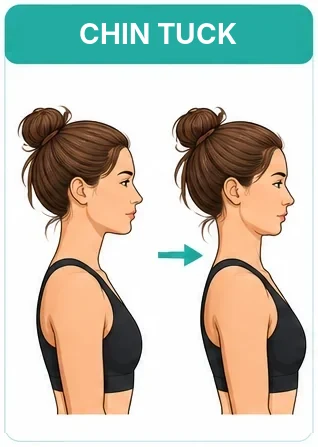
- Target: the deep muscles at the front of the neck that keep the head in line.
- How: Sitting or standing, looking straight ahead, draw your chin straight back, as if making a double chin. Do not tip your head down or back. You feel the pull at the back of the neck.
- Dose: 10× holding 5 s.
- Watch out: gently, without pressure. Stop if dizziness or tingling in the arm appears.
8. Head tilt
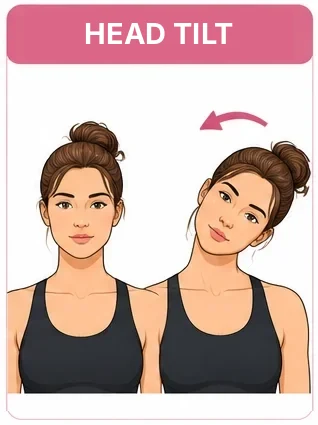
- Target: the side of the neck and the upper trapezius.
- How: Sitting or standing, tilt your head toward your shoulder and support it lightly with just the weight of your hand. Let the opposite shoulder drop, or hold the edge of the seat with that hand.
- Dose: 30 s per side, 1–2×.
- Watch out: no pulling the head with your hand. The pull is mild and does not travel into the arm.
4. What to use when
| What bothers you | Start with exercises |
|---|---|
| My hip pinches at the top of the stroke | 1, 2, 3 (and check the crank length) |
| My back hurts or stiffens after a longer ride | 1, 3, 4, 5 (and the saddle height and reach) |
| I feel I cannot reach a lower handlebar position | 1, 4, 5 |
| My neck or the area between the shoulder blades hurts | 6, 7, 8 (and the reach, that is the stem length) |
This is a signpost, not a diagnosis. If pain persists, start by checking your position: handlebars and reach, crank length and saddle height.
5. Mobility is not everything
Mobility without control is not enough. Studies of cyclists with back pain repeatedly find weaker endurance of the trunk and back muscles. Complement stretching with strengthening of the trunk and glutes, for example plank, side plank, bridge and a hip hinge with a straight back. Two short sessions a week are enough.
Pain that does not go away within 2–3 weeks, tingling, weakness or shooting pain into the leg or arm, night pain, pain after a fall, or a sharp pinch in the groin when bending the hip. In such cases reduce the exercise and see a doctor or physiotherapist.
The ComfiVelo app is being finished.Notify me
Details and sources
What studies say
- Holliday and Swart (2021), 50 men, flexibility measurement, bike setup and performance tests. Better hamstring mobility was associated with performance and with a greater forward tilt of the pelvis. Greater lumbar spine mobility was not an advantage: it was indirectly associated with relative VO2max.
- Review of studies on back pain in cyclists (Sports Health, 2017), 8 studies. Lower handlebars were associated with greater flexion of the lumbar spine. Cyclists with back pain had an imbalance in trunk muscle activation, lower endurance of the back muscles and a more rounded lower back. The quality of evidence is low (level 4).
- Jacobs et al. (1995), 45 men. Cyclists with neck pain did not have weaker neck muscles than those without pain. The authors suggest that pain arises more from fatigue of holding the head for a long time than from weakness. That is why you address the neck also through posture, reach and frequent changes of position, not only stretching.
- Behm et al. (2016), review of studies on stretching. Long static stretching (60 s or more per muscle group) reduced performance immediately after stretching by 4.6 % on average, shorter (up to 60 s) by 1.1 %. Dynamic stretching raised it slightly (by about 1.3 %). The increase in range of motion usually lasts up to 30 minutes. A clear effect on injuries was not proven. The authors recommend including stretching in a warm-up followed by dynamic activity.
- Ingram et al. (2024), meta-analysis of static stretching dosage. Roughly 10 minutes a week per muscle group improves flexibility, more adds nothing. In studies the most common protocol was one stretch held 30–60 s for 1 to 4 sets. The conclusions concern flexibility only, not performance or injury prevention.
- Prevalence of pain. According to overviews on Physiopedia, more than half of cyclists report lower back pain, and in recreational riders with a weekly distance of 160 km or more it was about 3.6× more common. An older figure puts neck or back problems at up to 60 % of riders. The numbers come from individual, rather old studies and different groups; treat them as indicative.
What studies cannot settle
Most works are observational or small, often with men only. None of it proves that this particular routine will remove pain while riding. The stretching dosage comes from general studies, not tests on cyclists. The choice of exercises is based on physiotherapists' practice and descriptions of routines for cyclists, not on a single study. Individual differences (hip structure, injuries, health condition) are large.
Sources
Holliday and Swart 2021, Sports Health 2017, review, Jacobs et al. 1995, Behm et al. 2016, Ingram et al. 2024, Physiopedia: Cyclist's Back, Physiopedia: Cyclist's Neck, Roadman: hip mobility, Brisbane Physiotherapy: thoracic spine, We Love Cycling: mobility.
The content is informative and does not replace a doctor or physiotherapist. The numbers come from abstracts and summaries; advice in the literature differs.